Largest Contentful Paint (LCP)
LoadingHow long the biggest visible element, often the main photo or a headline, takes to appear. Google calls 2.5 seconds or less good. Oversized images and a sluggish server cause most of the misses.

Speed Optimization
Speed work for Moncton businesses with customers on phones, from riders on a Codiac Transpo bus to drivers in a plaza parking lot and guests in a hotel room planning a weekend out.

A good deal of local searching in Moncton happens nowhere near a desk. Codiac Transpo riders look up an address between stops, a driver in a plaza parking lot types “restaurants moncton open now”, and visitors ask “tidal bore moncton times today” or “magnetic hill moncton hours” while already underway. Connections on the move can be patchy, and a page that feels instant on office Wi-Fi may turn into a real obstacle on a phone.
A slow page loses more than a ranking: the visitor gives up before the call button shows, before the menu opens or before the booking calendar has drawn itself. In Moncton the heaviest pages tend to be photographers’ galleries, restaurant menus saved as PDFs, map-based property searches and clinic sites that load several chat and booking widgets, and those are where speed work pays back.
The work begins with an audit of the pages your customers really open, tested with the tools Google uses, and ends with a single written quote. Staying fast afterwards is routine upkeep and belongs to your monthly plan.
Search demand
Google.ca suggestions from October 2026. People rarely search for speed work by city, so this table lists local searches typed on phones in a hurry, which is where a slow page loses the visit.
Look at what those searches want: a phone number, an address, opening times or a map pin. We build the first screen to deliver exactly that straight away, and everything heavy, such as galleries, embedded maps and chat widgets, waits until the visitor scrolls or taps. Your photos stay on the page; they simply no longer hold it up.
Common causes
A slow site usually has more than one of these at once.
Event, gallery and property photos uploaded at camera size, then displayed no bigger than a postcard. Cutting them to the size of their slot and saving them in a modern format often takes most of the weight off a page.
The visitor’s phone must fetch the entire file before a word appears, and the text inside is harder for Google to read. A normal web page with the same menu or event details opens sooner and is easier to find.
Chat bubbles, review carousels, social feeds, video and map embeds and several analytics tags each pull in code from somewhere else. Many were added years ago and no longer earn their place.
A heavy page builder ships a big package of code to every page, needed or not, so removing or slimming it frequently brings the largest single gain.
When the server is slow to answer, everything else queues behind it. Caching helps, and sometimes the only real cure is a better host.
What Google measures
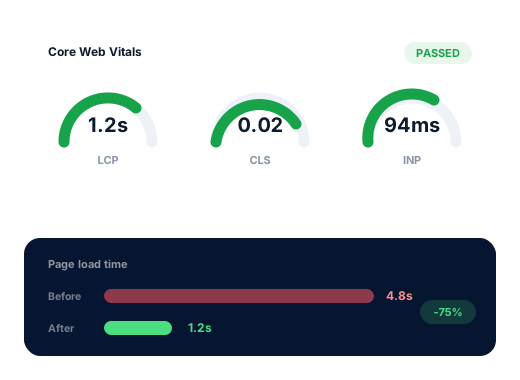
Google collects these numbers from real Chrome visits over the previous 28 days and grades the 75th percentile, which is roughly the slower end of a normal visit. A page that meets all three targets is rated good.
How long the biggest visible element, often the main photo or a headline, takes to appear. Google calls 2.5 seconds or less good. Oversized images and a sluggish server cause most of the misses.
How fast the page answers when someone taps a button, opens a menu or types in a form. Anything at 200 milliseconds or under is good, and heavy scripts from widgets and trackers are the usual drag.
How much the page jumps while it loads, such as a button sliding away just as a thumb arrives. A score of 0.1 or lower is good, and the usual causes are images with no set size and banners that appear late.
The work
Real-visitor data from Google, tests in the lab on a mid-range phone, and a ranked list of the heaviest items on each page that matters, so the work goes where it pays off.
Every image is trimmed to the size its slot needs, compressed, delivered as WebP or AVIF to browsers that support them and fetched only as the reader scrolls toward it.
Plugins nobody uses come out, chat and review widgets wait until a visitor asks for them, and tracking tags are merged without losing data you rely on.
Page and browser caching, plus a content delivery network where one helps, configured around how your particular site behaves.
Images and embeds get fixed dimensions, banners get reserved space, and fonts load without pushing text around while someone is reading.
Lab tests right after launch, then Google’s field figures once enough new visits have built up.
Done carefully
The standards we hold ourselves to on every account, set out in writing.
On its own, speed will not carry a thin page past a strong one, but it stops you losing visitors you have already won.
Speed is one of many signals Google uses and rarely decides a ranking on its own. What it reliably changes is how many visitors stay long enough to call, book or buy. The work is quoted once, in CAD, after an audit, and if a slow host or theme turns out to be the real problem we say so before you spend anywhere else.
Ask us about your business
How we work
The work opens with a close look at your listing and website, then settles into a short monthly report that takes a coffee break to read.
First we study your website and listing, then look at the results a searcher gets in downtown, Mapleton, Dieppe and Riverview.
Together we choose the searches worth winning and decide whether each calls for a new page or a profile fix.
Profile fixes, new pages, copy and tidying of directory entries, taking the likeliest quick wins first.
Each month brings a note of the calls, form messages and rankings we recorded, followed by our plan for the next four weeks.
Questions
Run your address through PageSpeed Insights and start with the mobile field data, which reflects real visits. Then open the site on your phone over mobile data, perhaps on a bus, and time how long it takes before the call button works.
Slightly, at times, particularly where competing pages are otherwise alike. The more dependable gain is that fewer visitors leave before contacting you.
Not the originals. A gallery can show properly sized, compressed previews that load as the visitor scrolls, with full-resolution images opening only on request, so the page stays quick and the work still looks its best.
Often it does. The entire file has to download before anything appears, and it is fiddly to read on a small screen. A web page version opens sooner, is simpler to update and hands Google real text.
The hands-on work on a typical small site takes one to two weeks, but Google’s real-visitor figures are a rolling 28-day window, so its reports trail the changes by roughly four weeks.
Each slow site has its own combination of causes, so we audit it first and send a single quote in CAD. When the project ends, keeping the site quick is routine upkeep inside your monthly plan, at no added charge.
Further reading
More reading on this topic for people who run a business in Greater Moncton.
You can take any service on its own, and many clients start with a single one.
Each trade is searched in its own way, so every industry page rests on research of its own.
Our free review shows how easily people find you from downtown to Dieppe and Riverview, which rivals sit above you and where to begin fixing things.
Request my free audit